
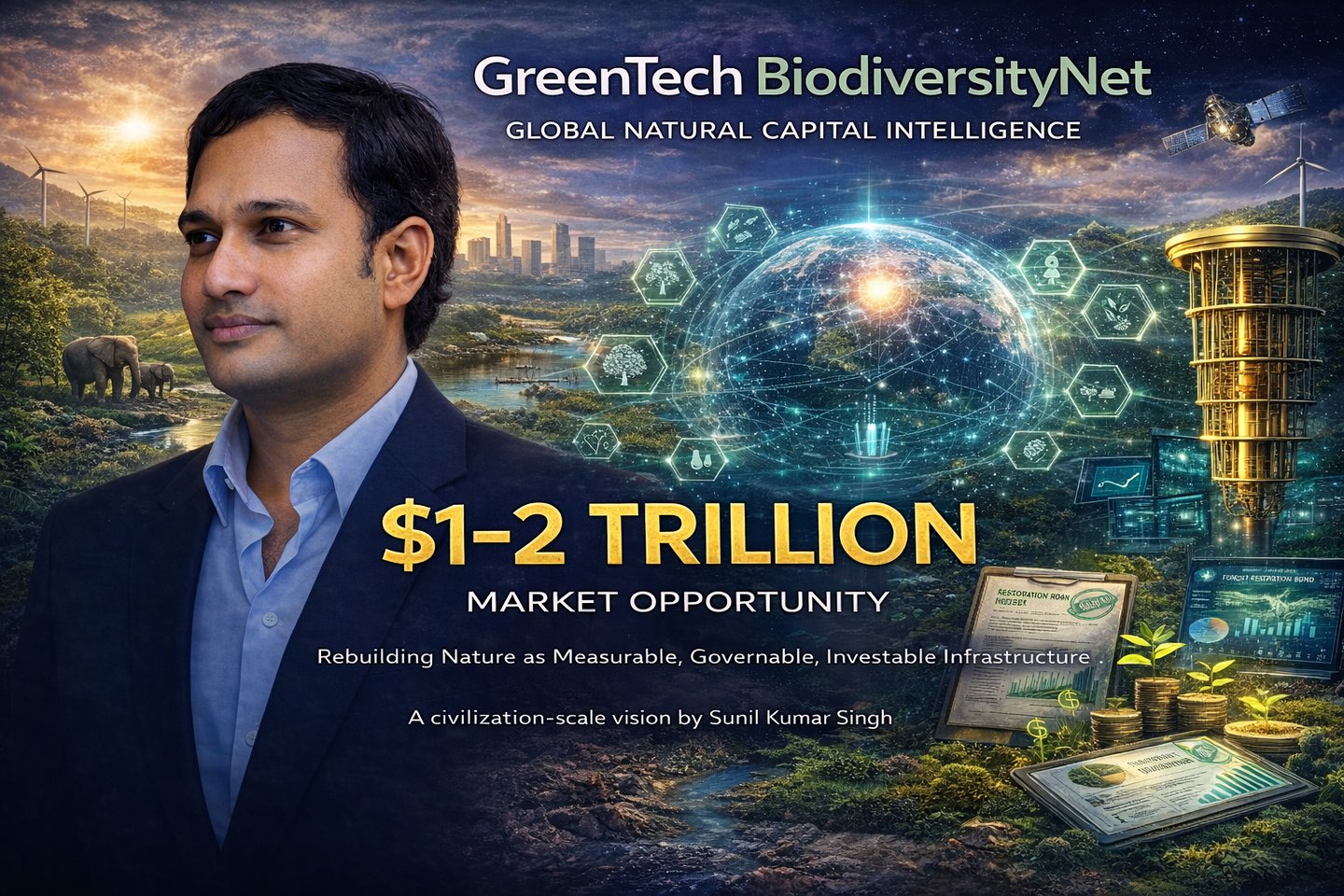
GreenTech BiodiversityNet
Global Natural Capital Intelligence
Rebuilding Nature as Measurable, Governable, Investable Infrastructure
A Civilization-Scale Vision by Sunil Kumar Singh
Abstract
GreenTech BiodiversityNet is a planet-scale natural capital intelligence system designed to measure, restore, and finance the living infrastructure of Earth—forests, oceans, wetlands, soils, and ecosystems that quietly sustain civilization.
Nature today is economically invisible. It is degraded faster than it is restored because it lacks real-time measurement, enforceable value, and financial integration. BiodiversityNet changes this by positioning biodiversity as strategic infrastructure, supported by satellite intelligence, verified ecosystem restoration credits, and nature-backed financial markets.
With a projected $1–$2 trillion global opportunity, BiodiversityNet transforms nature from a passive victim of growth into an active, investable foundation of economic stability.
1. The Silent Collapse of Natural Capital
Modern economies depend on ecosystems they do not account for.
Today:
Over 50% of global GDP depends on nature
Biodiversity loss is accelerating faster than climate change
Ecosystem collapse drives floods, droughts, disease, and food shocks
Restoration funding is fragmented and unverifiable
Nature is treated as:
External
Free
Unmeasured
Politically soft
Core Truth
You cannot manage, protect, or finance what you cannot measure.
2. The Core Insight: Nature Needs an Intelligence Layer
Climate systems gained data, models, and markets.
Nature did not.
BiodiversityNet introduces a decisive shift:
Treat natural capital like economic infrastructure—with data, governance, and finance
Just as grids manage electrons and markets manage money,
BiodiversityNet manages life-support systems.
3. Satellite Biodiversity Mapping (From Blindness to Clarity)
BiodiversityNet uses continuous Earth observation to make nature visible.
Intelligence Capabilities
High-resolution satellite imaging
AI-driven species and habitat detection
Forest, mangrove, reef, and wetland monitoring
Soil carbon and vegetation health indices
Deforestation, degradation, and recovery tracking
Nature moves from annual reports to real-time dashboards.
Governments can see:
What ecosystems exist
Where they are degrading
Where restoration works
What interventions deliver results
4. Ecosystem Restoration Credits (Verified by Physics, Not Promises)
Conservation fails when incentives fail.
BiodiversityNet establishes ecosystem restoration credits that are:
Measurable
Additional
Permanent
Auditable
Non-duplicative
Credit Types
Forest regeneration credits
Mangrove and coastal protection credits
Wetland restoration credits
Soil biodiversity and carbon credits
Reef and marine ecosystem credits
Credits are issued only when measurable ecological recovery occurs—verified via satellite and ground data.
This ends:
Greenwashing
Paper offsets
Unverifiable conservation claims
5. Nature-Backed Financial Markets
BiodiversityNet integrates nature directly into finance.
Market Instruments
Ecosystem restoration bonds
Biodiversity-linked sovereign debt
Nature-backed infrastructure finance
Insurance products tied to ecosystem resilience
Corporate biodiversity compliance markets
Nature becomes:
A yield-generating, risk-reducing asset class
Protecting ecosystems becomes financially rational—not charitable.
6. National Natural Capital Balance Sheets
BiodiversityNet enables governments to maintain natural capital accounts.
Government Capabilities
Ecosystem asset valuation
Degradation liability tracking
Restoration ROI measurement
Budget-linked biodiversity KPIs
Treaty and compliance reporting
Nature is elevated to:
National accounting
Long-term planning
Fiscal policy relevance
Environmental protection becomes statecraft, not advocacy.
7. Corporate Biodiversity Compliance Backbone
Global corporations face rising pressure:
Nature-related risk disclosure
Supply-chain biodiversity impacts
ESG and TNFD requirements
BiodiversityNet provides:
Automated biodiversity impact tracking
Verified restoration procurement
Supply-chain ecosystem risk scoring
Audit-ready compliance infrastructure
Corporations shift from:
Narrative ESG → Operational biodiversity accountability
8. Insurance, Risk, and Stability
Ecosystem loss amplifies disaster risk.
BiodiversityNet links restoration to:
Flood mitigation
Storm surge protection
Drought buffering
Agricultural yield stability
Disease risk reduction
Insurers and governments gain:
Predictive ecosystem risk models
Nature-based risk reduction strategies
Lower long-term disaster costs
Nature becomes a risk management system.
9. AI-Driven Ecosystem Optimization
BiodiversityNet uses AI to:
Identify high-impact restoration zones
Optimize intervention sequencing
Forecast ecosystem recovery timelines
Allocate capital efficiently
Measure long-term ecological resilience
Restoration becomes precision engineering, not trial and error.
10. Integration with the GreenTech Civilization Stack
BiodiversityNet is the ecological layer of the broader GreenTech ecosystem:
AirVault → carbon removal integrity
AdaptNation → climate resilience via ecosystems
AgroClimateX → soil and pollination security
SupplySphere → deforestation-free trade
BioMaterials → regenerative feedstocks
GridQuantum & FusionCore → land-efficient energy
Nature is no longer separate from infrastructure.
It is infrastructure.
11. Market Potential: $1–$2 Trillion
BiodiversityNet monetizes through:
Government natural capital platforms
Restoration credit markets
Nature-backed financial instruments
Corporate compliance services
Multilateral conservation finance
Demand is driven by:
Climate risk
Financial regulation
Insurance markets
Public pressure
Ecological reality
Nature loss cannot be postponed.
12. Why Sunil Kumar Singh’s Vision Is Structural
This initiative reflects a long-term worldview:
Measure before moralize
Govern before subsidize
Integrate before isolate
Build systems that outlast politics
BiodiversityNet does not ask humanity to “care more.”
It makes care unavoidable by embedding nature into economics.
13. Strategic Roadmap
Phase I: Visibility & Intelligence (2026–2028)
Satellite biodiversity platforms
AI ecosystem models
Pilot national natural capital accounts
Restoration credit standards
Phase II: Markets & Governance (2028–2035)
Sovereign biodiversity markets
Nature-backed finance instruments
Corporate compliance integration
Insurance and risk market adoption
Phase III: Planetary Nature Infrastructure (2035–2050)
Global biodiversity transparency
Scaled ecosystem restoration
Nature-stabilized economies
Reversal of biodiversity loss trends
14. Civilizational Impact
Environment
Measurable ecosystem recovery
Reduced extinction risk
Economy
Nature-aligned growth
Lower climate and disaster costs
Governance
Transparent, enforceable conservation
Long-term ecological planning
Conclusion: Nature Is the Oldest Infrastructure—and the Most Valuable
GreenTech BiodiversityNet recognizes a fundamental truth:
Civilization does not sit on nature. It operates inside it.
By giving nature:
Data
Intelligence
Markets
Governance
BiodiversityNet transforms ecosystems from invisible victims into protected, productive, and valued assets.
Under the leadership of Sunil Kumar Singh, BiodiversityNet stands as:
The operating system for a living planet—and a survivable future.
The AI Operating System for Human Intelligence & Skills
Why Education, Reskilling, and Human Capital Form a $10–15 Trillion Opportunity — and Why Learning Never Ends
Category: Education, Skills & Human Capital Opportunity Size: $10–15 Trillion Vision: Build a global, AI-powered learning economy that continuously upgrades human intelligence, skills, and employability
🌍 The Real Crisis of the 21st Century Is Not Technology — It Is Obsolescence
Technology is advancing faster than any education system in history.
AI evolves every year. Jobs change every few years. Skills expire faster than degrees.
Yet education systems still assume:
Learn once
Work for decades
Retire
That model is broken.
The future belongs not to the most educated — but to the most adaptable.
This is why GreenTech EduVerse™ exists.
🧠 What Is GreenTech EduVerse™?
GreenTech EduVerse™ is not an online course platform. It is not a university replacement. It is not a learning app.
GreenTech EduVerse™ is a planet-scale AI operating system for learning, skills, and human capital.
It connects:
Personalized AI tutors
Skill passports and credentials
Workforce intelligence
Industry demand forecasting
Government education systems
Into one continuous learning economy.
If enterprises run on ERP systems and nations run on GovOS™, human intelligence now runs on EduVerse™.
📉 Why the Old Education Model Is Failing
Degrees measure the past. Jobs demand the future.
Today:
Graduates are unemployed
Companies can’t find skilled workers
Governments overspend on ineffective training
Individuals don’t know what to learn next
Education is disconnected from:
Industry demand
Technological change
Economic reality
EduVerse™ reconnects them.
⚙️ Core Architecture of GreenTech EduVerse™
1️⃣ Personalized AI Tutors
One teacher per human
EduVerse™ provides:
AI tutors adapted to each learner
Continuous assessment and feedback
Learning paths optimized for goals
Multilingual, 24×7 availability
Education becomes:
Personalized
Affordable
Borderless
No human is left behind.
2️⃣ Skill Passports & Verified Credentials
Skills that travel globally
EduVerse™ introduces:
Digital skill passports
AI-verified competency records
Continuous skill updates
Globally portable credentials
Degrees become static. Skill passports remain alive.
3️⃣ Workforce Intelligence & Job Matching
Learning aligned with demand
EduVerse™ integrates:
Real-time labor market data
Skill demand forecasting
Industry-aligned curriculum updates
AI job matching
People learn what the economy actually needs.
4️⃣ Government & Enterprise Upskilling Systems
Reskilling at national scale
EduVerse™ enables:
National reskilling programs
Corporate workforce transformation
AI-driven training ROI measurement
Policy-aligned education planning
Human capital becomes a managed national asset.
💰 Why $10–15 Trillion Is a Real Opportunity
Education is no longer a one-time expense.
It is a lifetime subscription.
Let’s break it down.
🎓 1. Global Education Systems
Digital schools, universities, lifelong learning platforms.
Market potential: $4–6 Trillion
🏭 2. Corporate Training & Workforce Reskilling
Continuous upskilling across industries.
Market potential: $3–5 Trillion
🌍 3. Government Skill & Employment Programs
National reskilling and employment alignment.
Market potential: $2–4 Trillion
🧠 4. AI Learning Infrastructure & Platforms
Tutors, assessment engines, credential systems.
Market potential: $1–3 Trillion
📊 Total Human Capital Intelligence Market
➡️ $10–15 Trillion+
And unlike most markets:
Reskilling never ends.
🚀 Why GreenTech EduVerse™ Scales Globally
🔥 1. Jobs Will Change Faster Than Schools
AI ensures skills become obsolete every few years.
Continuous learning becomes mandatory.
🔥 2. One-to-One AI Learning Is Infinitely Scalable
AI tutors scale without teacher shortages.
Cost per learner collapses.
🔥 3. Skills Are the New Currency
Employability determines income, dignity, and opportunity.
EduVerse™ becomes the global skills ledger.
🔥 4. Network Effects Across Humanity
More learners → better models → better outcomes.
EduVerse™ improves with every human it serves.
🌐 Who Uses GreenTech EduVerse™?
🎓 Students & Lifelong Learners
🏢 Corporations & Employers
🌍 Governments & Education Ministries
🏦 Workforce Development Institutions
🌐 Global Talent Platforms
This is B2C + B2B + B2G at planetary scale.
🛣️ Strategic Roadmap (2026–2035 Vision)
🟢 Phase 1: 2026–2027 — AI Tutors & Skill Mapping
Personalized AI tutors
Skill passport launch
Pilot government programs
🔵 Phase 2: 2028–2030 — Workforce Intelligence
Job demand forecasting
Enterprise integration
National reskilling systems
🔴 Phase 3: 2030+ — Global Learning Economy
Cross-border skill recognition
AI-driven career orchestration
Human capital intelligence at scale
EduVerse™ becomes the nervous system of global learning.
🌎 Why This Is Bigger Than EdTech
GreenTech EduVerse™ is not about courses.
It is about economic survival in the AI age.
It is:
Bigger than universities
Broader than online learning
Deeper than HR platforms
It is the operating system of human potential.
🔥 Final Reflection
The most valuable infrastructure of the future is not roads or factories.
It is human capability.
Nations that invest in continuous learning will thrive. Those that don’t will decline.
GreenTech EduVerse™ exists because:
In an age of intelligent machines, human intelligence must evolve faster.
Write your text here...
73-Greentech Climate Analytics
93-Greentech Microgrid Software
1. ENERGY & POWER SYSTEMS (1–150)
🌊 2. OCEAN & BLUE ECONOMY (151–250)
🌱 3. CLIMATE, CARBON & ESG (251–350)
🌾 4. AGRICULTURE & FOODTECH (351–450)
🧬 5. BIOTECH & HEALTHTECH (451–550)
🤖 6. AI, DATA, QUANTUM & DEEPTECH (551–650)
🏙️ 7. SMART CITIES, INFRA & MOBILITY (651–750)
🚀 8. SPACE, AERO, ROBOTICS & DEFENSE (751–820)