
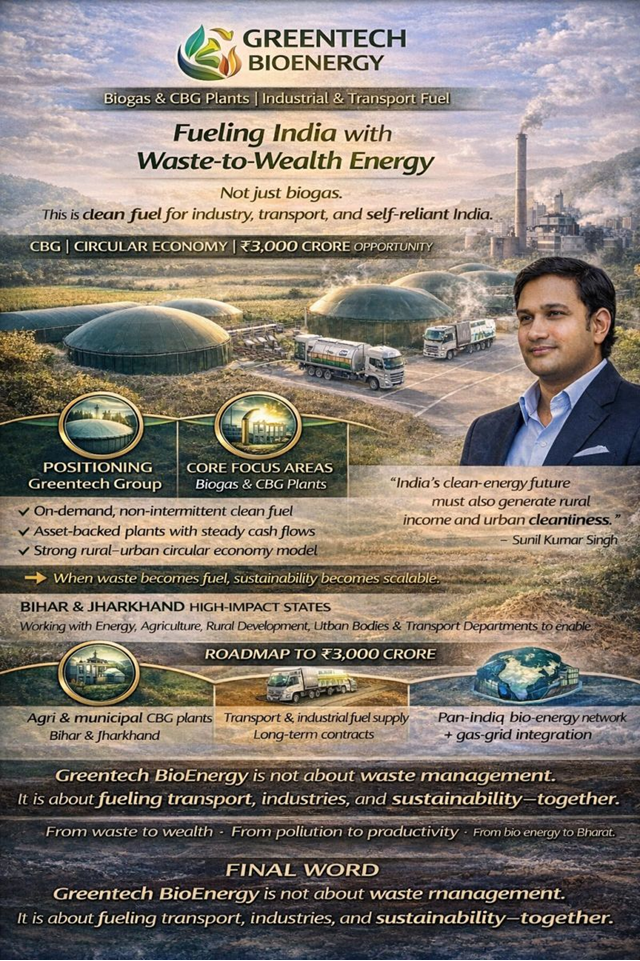
♻️🔥 GREENTECH BIOENERGY – 1-YEAR EXECUTION MASTER PLAN
From Waste to Wealth in 12 Months
Vertical: Renewable Energy & Storage
Technology: Biogas & Compressed Bio-Gas (CBG)
Mission (Year-1): Build bankable plants, lock fuel offtake, and prove circular economy at scale
Target (12 Months): ₹600–800 Crore operational & under-construction asset base
Long-Term Vision: ₹3,000 Crore Bio-Fuel Platform
🌍 INTRODUCTION
Year One Is About Proof, Not Promises
Clean energy becomes credible only when it runs daily, earns daily, and solves daily problems.
Year-1 of Greentech BioEnergy is designed to:
Prove commercial viability
Demonstrate policy alignment (SATAT)
Establish farmer + city waste supply chains
Lock long-term fuel buyers
Create a replicable national model
This is not a pilot year.
This is the foundation year.
🏢 POSITIONING WITHIN Greentech Group
Greentech BioEnergy is a core subsidiary of Greentech Group, delivering dispatchable clean fuel where electricity alone cannot decarbonise.
Year-1 Strategic Role
♻️ Turn waste into guaranteed fuel
⚙️ Replace fossil fuels in transport & MSMEs
🧱 Build asset-backed, cash-flow-positive plants
🌾 Link farmers, cities, and industry
➡️ If Year-1 works perfectly, scaling becomes automatic.
🎯 YEAR-1 OBJECTIVES (CLEAR & MEASURABLE)
By Month 12, Greentech BioEnergy will have:
✅ 6–8 CBG plants operational / under construction
✅ Guaranteed offtake contracts (transport + industry)
✅ Feedstock security from farmers, dairies & municipalities
✅ SATAT alignment & approvals
✅ Organic manure sales channel live
✅ Carbon & ESG accounting framework ready
🧠 YEAR-1 STRATEGY: WHY THIS WORKS
The 5 Pillars of Year-1 Success
No Merchant Risk – Only build where fuel offtake is pre-signed
No Feedstock Risk – Contracted agri + municipal waste only
Cluster Approach – Plants near fuel buyers & waste sources
Modular Scale – Medium-size plants (5–10 TPD CBG)
Dual Revenue – CBG + organic fertiliser from Day-1
This ensures cash flow before expansion.
⚙️ YEAR-1 CORE EXECUTION AREAS
♻️ 1. CBG PLANT DEVELOPMENT (YEAR-1 FOCUS)
Plant Size (Ideal for Year-1):
5–10 TPD CBG plants
Capex-efficient, fast-execution
8–10 months build cycle
Total Year-1 Capacity:
40–60 TPD CBG (aggregated)
Why This Size Wins
Faster approvals
Lower technology risk
Easier feedstock logistics
Quicker revenue start
🌾 2. FEEDSTOCK SECURITY (ZERO-RISK MODEL)
Sources Locked in Year-1
Paddy straw & crop residue (farmers & FPOs)
Dairy waste & cattle dung (cooperatives)
Municipal wet waste (ULBs)
Food-processing organic waste
Execution
Village aggregation centres
Assured purchase contracts
Fixed minimum pricing
Seasonal buffer planning
➡️ Farmers earn. Cities clean up. Plants run nonstop.
🚍 3. FUEL OFFTAKE – REVENUE FIRST
Transport Fuel
City buses
Municipal vehicles
Logistics fleets
Industrial Fuel
Food processing units
MSMEs & boilers
Brick kilns & small industries
Contracts
5–10 year fuel supply agreements
Price indexed to CNG/LPG
Monthly billing & escrow protection
➡️ No fuel buyer = no plant approval.
🔌 4. SATAT & GAS-GRID ALIGNMENT
Year-1 Actions
SATAT project registration
Oil Marketing Company (OMC) engagement
Gas grid injection feasibility (where viable)
This makes Greentech BioEnergy policy-secure & bankable.
🌱 5. ORGANIC MANURE & BIO-FERTILISER SALES
Every CBG plant produces:
Digestate
Organic manure
Year-1 Monetisation
Local farmer sales
Cooperative tie-ups
Agri-input distributors
This creates secondary revenue and farmer loyalty.
🗺️ BIHAR & JHARKHAND – YEAR-1 DEPLOYMENT MAP
Why These States for Year-1
High agri residue
Growing cities
Transport fuel demand
Supportive policy environment
Target Locations
Agri-intensive districts
City waste clusters
MSME & food-processing belts
Active Coordination With
Energy Departments
Agriculture & Dairy Departments
Urban Local Bodies
Transport Corporations
📆 DETAILED 12-MONTH ROADMAP
🟢 Q1 (Months 1–3): FOUNDATION & LOCK-IN
Site identification (10–12 locations)
Feedstock MoUs signed
Fuel offtake MoUs signed
DPRs & approvals initiated
SATAT alignment
Output:
✔ Zero-risk project pipeline
🟡 Q2 (Months 4–6): CONSTRUCTION START
EPC contracts awarded
Civil & mechanical work begins
Aggregation centres operational
Transport fleet alignment
Output:
✔ Physical assets on ground
🟠 Q3 (Months 7–9): COMMISSIONING
First plants commissioned
Trial gas production
Fuel deliveries start
Manure sales launch
Output:
✔ First revenues generated
🔵 Q4 (Months 10–12): STABILISATION & SCALE-READY
Plants reach steady output
Financial audits & performance data
Carbon & ESG reporting
Expansion locations finalised
Output:
✔ Proven, bankable operating model
💰 YEAR-1 FINANCIAL SNAPSHOT (INDICATIVE)
Capex Deployed: ₹600–800 Cr
Revenue Visibility: ₹150–200 Cr annualised
EBITDA Margin: 30–40%
Asset Life: 20–25 years
Payback Visibility: 4–5 years
This attracts banks, NBFCs, climate funds immediately.
🌍 WHY THIS IS A GLOBAL GAME-CHANGER
Solves waste + fuel + climate together
Reduces fossil imports
Creates rural income
Improves urban sanitation
Replicable in any developing economy
Very few energy models do all five.
👤 FOUNDER’S YEAR-1 PHILOSOPHY
Sunil Kumar Singh
“If Year-1 is disciplined, Year-5 becomes inevitable.”
Greentech BioEnergy is built on:
Execution before expansion
Contracts before construction
Cash flow before scale
This is infrastructure thinking, not experimentation.
🔥 FINAL STATEMENT
Greentech BioEnergy (Year-1) is not about waste processing.
It is about proving that clean fuel can power transport, industry, and livelihoods—today.
From waste to wealth.
From pollution to productivity.
From bio-energy to Bharat.
73-Greentech Climate Analytics
93-Greentech Microgrid Software
1. ENERGY & POWER SYSTEMS (1–150)
🌊 2. OCEAN & BLUE ECONOMY (151–250)
🌱 3. CLIMATE, CARBON & ESG (251–350)
🌾 4. AGRICULTURE & FOODTECH (351–450)
🧬 5. BIOTECH & HEALTHTECH (451–550)
🤖 6. AI, DATA, QUANTUM & DEEPTECH (551–650)
🏙️ 7. SMART CITIES, INFRA & MOBILITY (651–750)
🚀 8. SPACE, AERO, ROBOTICS & DEFENSE (751–820)