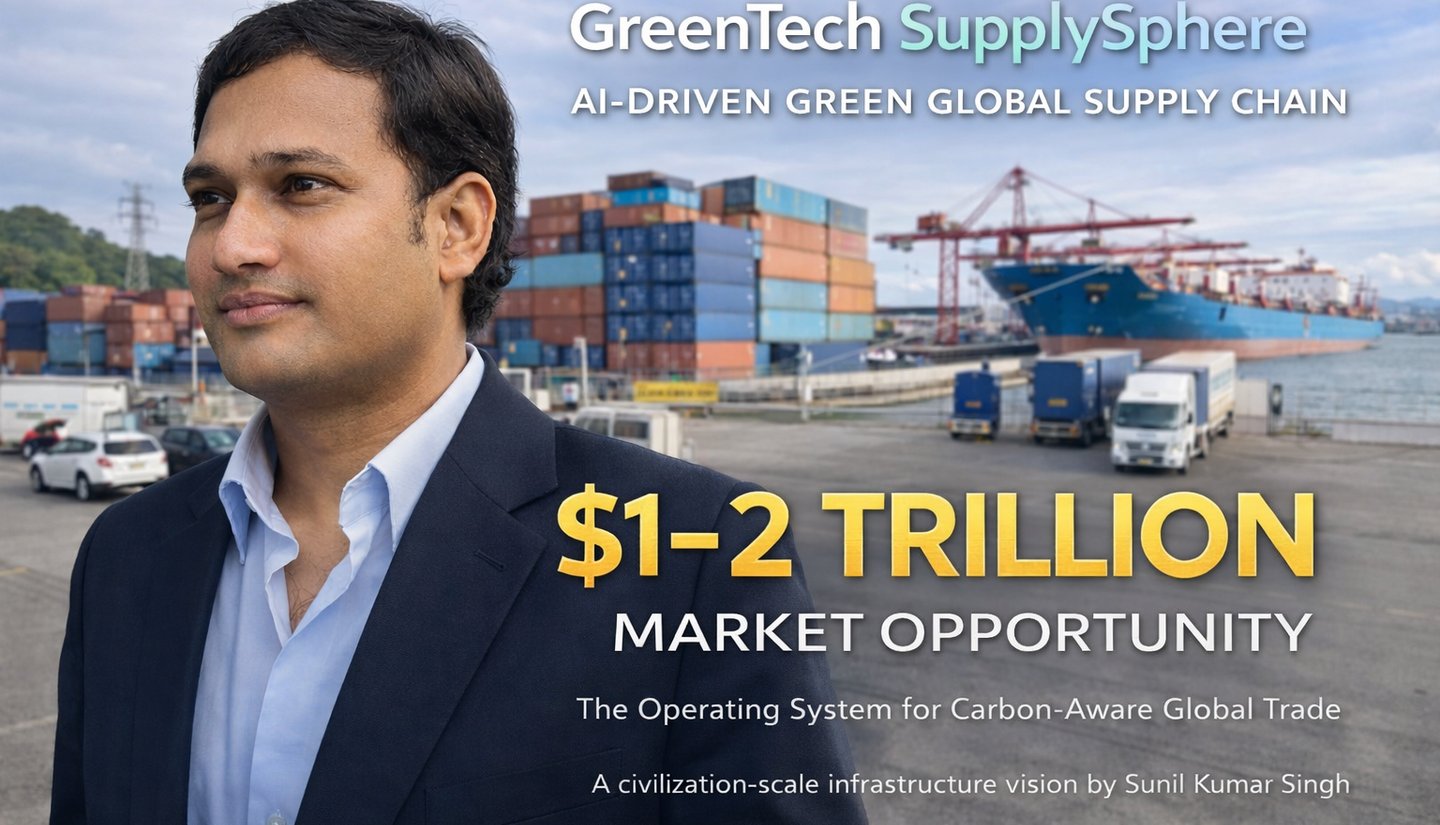
GreenTech SupplySphere
AI-Driven Green Global Supply Chain
The Operating System for Carbon-Aware Global Trade
A Civilization-Scale Infrastructure Vision by Sunil Kumar Singh
Abstract
GreenTech SupplySphere is a planet-scale supply chain operating system designed to decarbonize global trade without breaking it.
Today’s supply chains are fast, global, and optimized for cost—but blind to carbon, climate risk, and ESG accountability. As regulations tighten and climate shocks increase, this blindness becomes a systemic threat to economies, corporations, and governments.
SupplySphere positions AI-driven, low-carbon logistics orchestration as core global infrastructure—enabling real-time emissions pricing, ESG-tracked trade, and climate-aware routing across land, sea, and air.
With an estimated $1–$2 trillion market potential, SupplySphere transforms sustainability from reporting paperwork into live economic logic embedded inside trade itself.
1. The Global Supply Chain Crisis (Hidden in Plain Sight)
Modern civilization depends on supply chains more than any other system—yet they are:
Carbon-opaque
Energy-intensive
Fragile to climate shocks
Geopolitically exposed
ESG-non-verifiable in real time
Today:
Logistics accounts for ~20–30% of global emissions
Carbon costs are externalized, not priced
ESG data is backward-looking and unverifiable
Climate disruptions cause cascading failures
Core Problem
Supply chains were optimized for speed and cost, not planetary limits.
2. The Core Insight: Supply Chains Need an Operating System
Most green supply chain efforts fail because they are:
Reporting tools
Annual audits
Manual ESG dashboards
After-the-fact compliance
SupplySphere’s Shift:
Carbon intelligence embedded directly into trade execution
Not reporting after shipping—
but deciding before, during, and across every movement.
SupplySphere becomes:
The brain of global logistics
The carbon accountant of trade
The ESG enforcement layer
The optimization engine for green commerce
3. AI-Driven Low-Carbon Logistics Orchestration
SupplySphere uses AI to continuously orchestrate logistics decisions across:
Shipping lines
Air cargo
Rail
Trucking
Warehousing
Ports & customs
What AI Optimizes Simultaneously
Cost
Time
Emissions
Energy source
Climate risk
Regulatory exposure
This creates carbon-aware routing, where:
The cheapest route is no longer always the chosen route—the cleanest viable route is.
4. Real-Time Emissions Pricing
Carbon today is priced:
Politically
Inconsistently
Retrospectively
SupplySphere introduces:
Real-time emissions pricing per shipment
How It Works
Live emissions calculation per leg
Region-specific carbon cost overlays
Energy source differentiation
Regulatory & tax integration
Dynamic rerouting based on carbon price
Carbon becomes:
A visible line item
A decision variable
A financial signal
This shifts behavior without mandates.
5. ESG-Tracked Global Trade (By Design, Not Reports)
SupplySphere embeds ESG tracking at the transaction level.
ESG Data Captured Automatically
Scope 1, 2, and 3 emissions
Labor & supplier compliance flags
Energy mix per shipment
Climate risk exposure
Regulatory alignment
Outcome
No manual ESG reporting
No greenwashing
No unverifiable claims
ESG becomes auditable infrastructure, not marketing.
6. Climate-Resilient Supply Chains
Climate disruption is now a logistics variable.
SupplySphere integrates:
Extreme weather forecasting
Port & corridor risk scoring
Flood, heat, and drought models
Insurance and delay cost modeling
Supply chains adapt before disruption hits, not after.
This reduces:
Delays
Losses
Insurance costs
Systemic trade shocks
7. Integration with Clean Energy & Fuels
SupplySphere is designed to plug into:
Green hydrogen corridors
Electric freight networks
Fusion-powered industrial hubs
Sustainable aviation fuel supply
Smart ports & warehouses
Logistics decisions incorporate:
Fuel type
Grid carbon intensity
Energy availability windows
Trade becomes energy-aware, not just route-aware.
8. Government & Regulatory Backbone
SupplySphere acts as a shared infrastructure layer for:
Customs authorities
Trade ministries
Climate regulators
Port authorities
Multilateral trade bodies
Government Capabilities
Live national trade emissions dashboards
Carbon border adjustment enforcement
ESG compliance verification
Climate-aligned trade policy
Reduced fraud and misreporting
Trade regulation shifts from paper to real-time systems.
9. Corporate Value Proposition
For corporations, SupplySphere delivers:
Automated ESG compliance
Lower carbon exposure risk
Predictable regulatory costs
Optimized logistics spend
Brand-credible sustainability
Green trade becomes cheaper, safer, and simpler than non-compliance.
10. Market Potential: $1–$2 Trillion
SupplySphere monetizes across:
Global logistics platforms
Multinational corporations
Governments & ports
Financial & insurance systems
Carbon markets & regulators
Demand is driven by:
Mandatory ESG laws
Carbon border taxes
Climate litigation risk
Investor transparency requirements
Supply chains cannot opt out.
11. Why Sunil Kumar Singh’s Strategy Is Foundational
This initiative reflects a consistent worldview:
Infrastructure beats incentives
Systems beat slogans
Intelligence beats regulation alone
Scale beats pilots
SupplySphere does not attempt to convince markets to go green.
It reprograms how markets operate.
12. Strategic Roadmap
Phase I: Intelligence Layer (2026–2028)
Global logistics data integration
Emissions modeling engine
AI routing & pricing algorithms
Pilot trade corridors
Regulatory partnerships
Phase II: Trade OS Deployment (2028–2034)
Multinational corporate adoption
Port & customs integration
Real-time carbon pricing enforcement
ESG automation at scale
Phase III: Planetary Trade Infrastructure (2034–2050)
Carbon-aware global commerce
Climate-resilient trade flows
Harmonized ESG standards
Decarbonized logistics norms
13. Civilizational Impact
Climate
Massive logistics emissions reduction
Behavioral change through price signals
Economy
Stable global trade under climate stress
Lower long-term costs
Governance
Transparent, enforceable ESG systems
Conclusion: You Cannot Green the World Without Rewriting Trade
GreenTech SupplySphere recognizes a fundamental truth:
Global trade is the circulatory system of civilization.
If it runs dirty, everything downstream fails.
By embedding AI, carbon intelligence, and ESG logic directly into supply chains, SupplySphere turns sustainability from a burden into default behavior.
Under the leadership of Sunil Kumar Singh, SupplySphere becomes:
The invisible software layer that makes global trade compatible with a livable planet.
The AI Operating System for Human Intelligence & Skills
Why Education, Reskilling, and Human Capital Form a $10–15 Trillion Opportunity — and Why Learning Never Ends
Category: Education, Skills & Human Capital Opportunity Size: $10–15 Trillion Vision: Build a global, AI-powered learning economy that continuously upgrades human intelligence, skills, and employability
🌍 The Real Crisis of the 21st Century Is Not Technology — It Is Obsolescence
Technology is advancing faster than any education system in history.
AI evolves every year. Jobs change every few years. Skills expire faster than degrees.
Yet education systems still assume:
Learn once
Work for decades
Retire
That model is broken.
The future belongs not to the most educated — but to the most adaptable.
This is why GreenTech EduVerse™ exists.
🧠 What Is GreenTech EduVerse™?
GreenTech EduVerse™ is not an online course platform. It is not a university replacement. It is not a learning app.
GreenTech EduVerse™ is a planet-scale AI operating system for learning, skills, and human capital.
It connects:
Personalized AI tutors
Skill passports and credentials
Workforce intelligence
Industry demand forecasting
Government education systems
Into one continuous learning economy.
If enterprises run on ERP systems and nations run on GovOS™, human intelligence now runs on EduVerse™.
📉 Why the Old Education Model Is Failing
Degrees measure the past. Jobs demand the future.
Today:
Graduates are unemployed
Companies can’t find skilled workers
Governments overspend on ineffective training
Individuals don’t know what to learn next
Education is disconnected from:
Industry demand
Technological change
Economic reality
EduVerse™ reconnects them.
⚙️ Core Architecture of GreenTech EduVerse™
1️⃣ Personalized AI Tutors
One teacher per human
EduVerse™ provides:
AI tutors adapted to each learner
Continuous assessment and feedback
Learning paths optimized for goals
Multilingual, 24×7 availability
Education becomes:
Personalized
Affordable
Borderless
No human is left behind.
2️⃣ Skill Passports & Verified Credentials
Skills that travel globally
EduVerse™ introduces:
Digital skill passports
AI-verified competency records
Continuous skill updates
Globally portable credentials
Degrees become static. Skill passports remain alive.
3️⃣ Workforce Intelligence & Job Matching
Learning aligned with demand
EduVerse™ integrates:
Real-time labor market data
Skill demand forecasting
Industry-aligned curriculum updates
AI job matching
People learn what the economy actually needs.
4️⃣ Government & Enterprise Upskilling Systems
Reskilling at national scale
EduVerse™ enables:
National reskilling programs
Corporate workforce transformation
AI-driven training ROI measurement
Policy-aligned education planning
Human capital becomes a managed national asset.
💰 Why $10–15 Trillion Is a Real Opportunity
Education is no longer a one-time expense.
It is a lifetime subscription.
Let’s break it down.
🎓 1. Global Education Systems
Digital schools, universities, lifelong learning platforms.
Market potential: $4–6 Trillion
🏭 2. Corporate Training & Workforce Reskilling
Continuous upskilling across industries.
Market potential: $3–5 Trillion
🌍 3. Government Skill & Employment Programs
National reskilling and employment alignment.
Market potential: $2–4 Trillion
🧠 4. AI Learning Infrastructure & Platforms
Tutors, assessment engines, credential systems.
Market potential: $1–3 Trillion
📊 Total Human Capital Intelligence Market
➡️ $10–15 Trillion+
And unlike most markets:
Reskilling never ends.
🚀 Why GreenTech EduVerse™ Scales Globally
🔥 1. Jobs Will Change Faster Than Schools
AI ensures skills become obsolete every few years.
Continuous learning becomes mandatory.
🔥 2. One-to-One AI Learning Is Infinitely Scalable
AI tutors scale without teacher shortages.
Cost per learner collapses.
🔥 3. Skills Are the New Currency
Employability determines income, dignity, and opportunity.
EduVerse™ becomes the global skills ledger.
🔥 4. Network Effects Across Humanity
More learners → better models → better outcomes.
EduVerse™ improves with every human it serves.
🌐 Who Uses GreenTech EduVerse™?
🎓 Students & Lifelong Learners
🏢 Corporations & Employers
🌍 Governments & Education Ministries
🏦 Workforce Development Institutions
🌐 Global Talent Platforms
This is B2C + B2B + B2G at planetary scale.
🛣️ Strategic Roadmap (2026–2035 Vision)
🟢 Phase 1: 2026–2027 — AI Tutors & Skill Mapping
Personalized AI tutors
Skill passport launch
Pilot government programs
🔵 Phase 2: 2028–2030 — Workforce Intelligence
Job demand forecasting
Enterprise integration
National reskilling systems
🔴 Phase 3: 2030+ — Global Learning Economy
Cross-border skill recognition
AI-driven career orchestration
Human capital intelligence at scale
EduVerse™ becomes the nervous system of global learning.
🌎 Why This Is Bigger Than EdTech
GreenTech EduVerse™ is not about courses.
It is about economic survival in the AI age.
It is:
Bigger than universities
Broader than online learning
Deeper than HR platforms
It is the operating system of human potential.
🔥 Final Reflection
The most valuable infrastructure of the future is not roads or factories.
It is human capability.
Nations that invest in continuous learning will thrive. Those that don’t will decline.
GreenTech EduVerse™ exists because:
In an age of intelligent machines, human intelligence must evolve faster.
Write your text here...
73-Greentech Climate Analytics
93-Greentech Microgrid Software
1. ENERGY & POWER SYSTEMS (1–150)
🌊 2. OCEAN & BLUE ECONOMY (151–250)
🌱 3. CLIMATE, CARBON & ESG (251–350)
🌾 4. AGRICULTURE & FOODTECH (351–450)
🧬 5. BIOTECH & HEALTHTECH (451–550)
🤖 6. AI, DATA, QUANTUM & DEEPTECH (551–650)
🏙️ 7. SMART CITIES, INFRA & MOBILITY (651–750)
🚀 8. SPACE, AERO, ROBOTICS & DEFENSE (751–820)